Search for lipo foam or an abdominal board and look at who is answering. Almost every result is a company that sells them.
That is not a conspiracy, it is just how the internet works when a product has a search volume and no research behind it. But it does mean the person explaining whether you need one has an obvious reason to say yes.
We do not sell either. We see them on a dozen abdomens a week, correctly and incorrectly worn, so here is what each one physically does, what the evidence actually supports, and how to tell when yours is working against you.
What lipo foam actually is
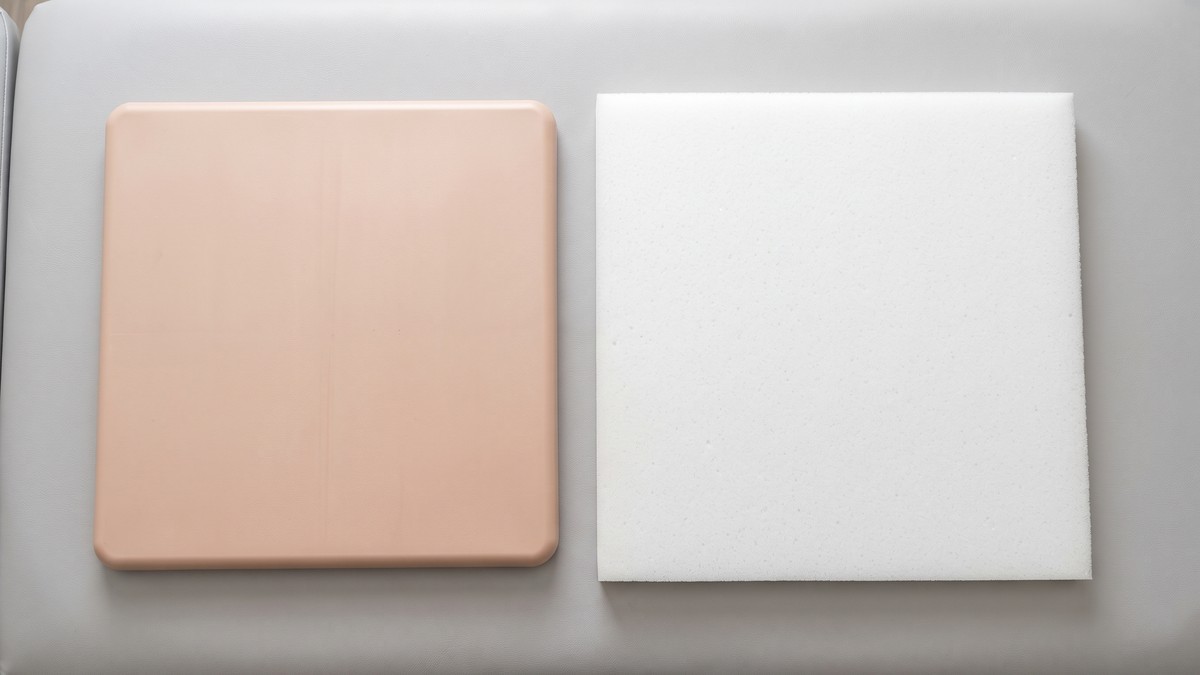
Lipo foam is a flat sheet of open-cell foam, usually white, cut to sit between your skin and your compression garment.
Its job is not compression. Your garment provides that. The foam’s job is to spread that pressure evenly across the surface underneath it. A garment on bare skin presses hardest wherever its seams, panels and edges sit, and least where the fabric bridges a hollow. Foam turns an uneven load into a more uniform one.
That matters most in the first weeks after liposuction, when the tissue is soft, swollen and easily marked. A seam that leaves a groove in inflamed tissue is a seam that is obstructing drainage exactly where it sits.
What an abdominal board actually is
An ab board is a rigid or semi-rigid flat panel, worn over the foam and under the garment, across the abdomen.
It does something different: it imposes a flat plane. Where foam smooths out pressure, a board resists the abdomen’s natural tendency to bow outward under a garment, and it discourages fluid from pocketing in the lower abdomen above the incision.
Boards are also the layer most often blamed for discomfort, because a rigid panel that is the wrong size or sits at the wrong height digs into the ribs above or the pubic bone below.
They are not alternatives to each other
The most common misunderstanding is treating this as a choice. Foam distributes pressure; a board imposes a shape. They do different jobs and are frequently used together, in this order against the body: skin, foam, board, garment.
Whether you need one, the other, both or neither is your surgeon’s call, and it depends on your procedure, your tissue and your closure.
What the evidence actually says, which is not much
Here is the part the product pages leave out. There is no published randomized trial comparing foam to boards, or either one to nothing, after liposuction or abdominoplasty. The practice is convention supported by clinical experience, not by trial data.
What we do have is evidence on the layer above them, compression, and it is more interesting than most people expect.
Fontes de Moraes and colleagues, writing in Aesthetic Surgery Journal in 2023, randomized 32 women after abdominoplasty to wear a compression garment or none. After post-operative day 35, the group without a garment had significantly lower waist circumference than the group wearing one (P < .001).
Bruno and Saccoccio went further in Aesthetic Plastic Surgery in 2026, randomizing 120 patients after abdominoplasty with diastasis repair to one, three or five months of class-II compression. At six months the change in inter-recti distance was essentially identical across all three groups, at 1.2, 1.3 and 1.4 mm. The one-month protocol was non-inferior, and longer compression was associated with slower resolution of swelling and higher intra-abdominal pressure during months one to three.
Neither trial studied foam or boards. But both point the same direction, and it is the opposite of what the accessories market implies: more pressure, for longer, is not automatically better. The useful question is not how much you are wearing, it is whether what you are wearing fits.
How to tell yours is doing harm
Take the whole setup off and look at the skin. Then check for these:
- Deep grooves or ridges that are still clearly visible thirty minutes after removal. A faint impression is fine. A trench is a pressure point, and a pressure point obstructs the drainage the garment is supposed to support.
- The board’s edges biting into the ribs, the hip bones or the pubic bone. That is a sizing or positioning problem, not something to endure.
- Numbness, tingling or a cold foot — take it off and call your surgeon’s office.
- Skin that stays red, blistered or broken under a seam or an edge.
- The board sliding out of position every time you sit. A board that migrates is applying pressure somewhere it was not intended.
- Pain that starts when you put it on. Snug is expected. Painful is not.
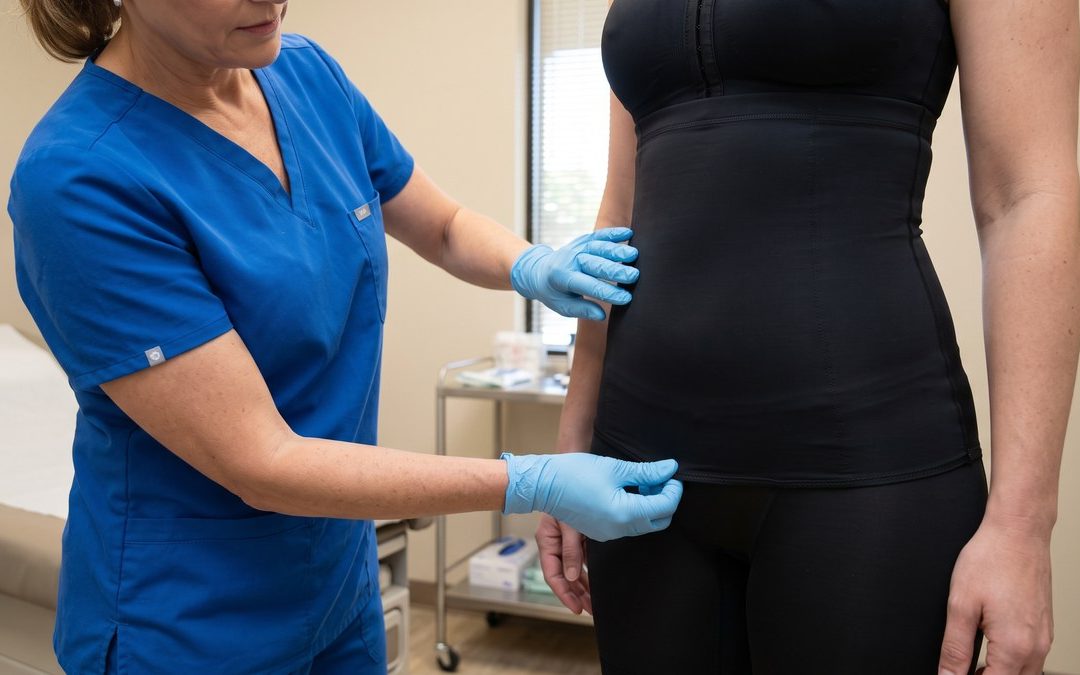
Bring the whole setup to a session and we will look at it with you. Garment assistance is included with post-operative treatment, and this is one of the more useful fifteen minutes of a visit.
When to start and how long to wear it
Your surgeon decides, and protocols vary more than patients expect. In practice most people begin foam and board once the initial dressings come off, and taper alongside their garment schedule.
Given the compression trials above, if you are being told to wear a board aggressively for five or six months, that is worth a conversation with your surgeon rather than an assumption.
Keeping them clean
Foam sits against skin, incisions and surgical fluid. Most foam is replaced rather than laundered, and a sheet that has gone yellow, stiff or smells is finished. Boards wipe clean. If anything touches an open incision or drainage, follow your surgeon’s wound-care instructions rather than a general cleaning tip.
What neither one will do
- Neither removes fibrosis. Firm, ropey tissue is addressed with hands-on work and time, not with pressure alone.
- Neither flattens a dog ear. Dog ears are structural and are a surgical conversation.
- Neither replaces your garment, and neither replaces movement. Short, frequent walking does more for early swelling than any accessory.
- Neither speeds up your final result. Contour is generally judged between six and twelve months, whatever you wear under your clothes.
Where this fits in recovery
Foam and boards are a small part of a bigger picture. If you are still early, the shape of normal swelling is the more useful thing to understand, and the week-by-week calendar covers what you can safely do at each stage.
Post-operative care in Houston and The Woodlands
Carolina Pintos is a licensed massage therapist and certified lymphedema therapist whose practice is built around post-surgical recovery, with rooms in Memorial and in The Woodlands. Fitting help for garments, foam and boards is part of a session rather than an extra.
References
- Fontes de Moraes BZ, Ferreira LM, Martins MRC, Rostom L, Castro HAS, Nahas FX. Do compression garments prevent subcutaneous edema after abdominoplasty? Aesthet Surg J. 2023;43(3):329-336.
- Bruno A, Saccoccio V. Is longer better? Revisiting compression duration after abdominoplasty with diastasis repair. Aesthetic Plast Surg. 2026;50(7):2633-2646.
- Liao CD, Zhao K, Nikkhahmashineh N, Bui DT. Decreasing seroma incidence following abdominoplasty: a systematic review and meta-analysis of high-quality evidence. Aesthet Surg J Open Forum. 2024;6:ojae016.
This article is general education, not medical advice. It does not establish a therapist-patient relationship and it does not replace the instructions of the surgeon who performed your procedure. Always follow your surgeon’s protocol and contact their office with any concern about your recovery.
This writing is the original and exclusive property of Carolina Pintos and is protected under copyright law. Unauthorized use of the same without the express consent of Carolina Pintos will be subject to prosecution under applicable laws.