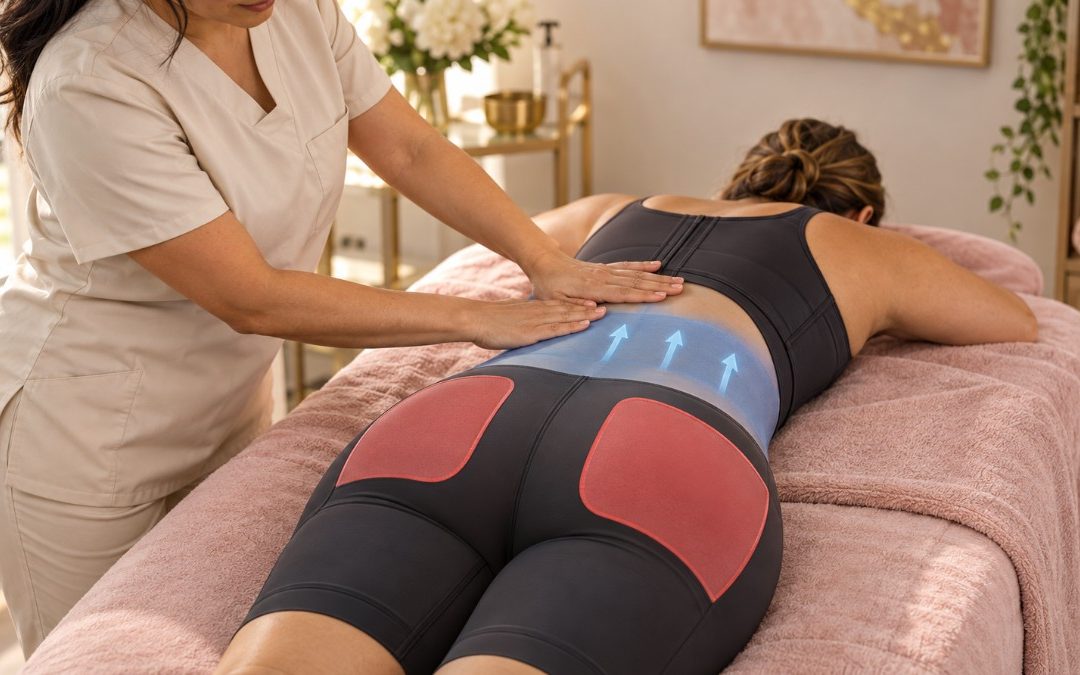

No. Properly performed manual lymphatic drainage is one of the lightest techniques in manual therapy. If your post-operative massage is painful enough that you brace through it, you are not receiving lymphatic drainage. You are receiving something else, and in our experience it tends to make recovery longer rather than shorter.
What Is Actually Being Sold
Search social media for post-operative massage and you will find videos of therapists pressing hard enough to force fluid out through liposuction incisions. Some keep the incisions open deliberately. Some lift scabs off to make a site drain again. Very often the sound is muted, because of what the patient is doing.
This is marketed as lymphatic drainage. It is not the same thing, and the distinction is not a matter of style.
How Light Manual Lymphatic Drainage Actually Is
The superficial lymphatic vessels that this technique works with sit just under the skin and are thin-walled. They respond to very light, rhythmic stretch of the tissue. Press hard and you do not move more fluid; you work past the structures you are trying to influence.
A 2025 study in Breast Cancer Research and Treatment measured the pressures therapists actually apply during manual lymphatic drainage. Across treatment stages the recorded pressures ranged from roughly 16 to 34 mmHg, with the lightest work in earlier stages and firmer pressure reserved for the most advanced, fibrotic tissue.
To put that in context, the lower end of that range is close to the weight of a resting hand. It is nothing like the force required to push fluid out through a healing incision.
The same study concluded that pressure should be matched to the stage of the tissue rather than applied uniformly. That is the whole principle. The technique adapts to where the body is in healing. It does not override it.
Why Forcing It Backfires
Surgery is a controlled trauma, and your body answers it with an inflammatory process. That process has stages. First the acute inflammatory phase, then remodelling and rebuilding. Swelling in those early weeks is not a malfunction. It is the process working.
Aggressive manual work during the acute phase adds new trauma to tissue that is already inflamed. Each session that hurts is, in effect, a fresh injury, and the body restarts its inflammatory response to it. Rather than moving through the phases of healing, the tissue is repeatedly pulled back to the beginning.
The consequence we see clinically is more scar tissue, not less. Patients arrive at our clinic with fibrosis that is more extensive than their stage of recovery would predict, and a history of painful sessions elsewhere.
We should be straightforward about the evidence here. We are not aware of published research demonstrating that forcing fluid through incisions improves healing, and the physiology points the other way. The published work supports the opposite approach: a 2026 review of manual lymphatic drainage after body plastic surgery concluded that, performed by trained professionals, it helps control edema, reduces pain and supports the prevention of complications.
What the Better Approach Looks Like in the Data
A controlled trial in the Revista Brasileira de Cirurgia Plastica followed women recovering from abdominoplasty and liposuction and compared a structured programme of care against standard treatment. Fibrosis resolved in 11.7 days in the structured group against 48.6 days with standard care. Bruising resolved in 7.8 days against 17.6. The structured group also needed fewer sessions overall, 14.6 against 23.1.
That trial tested a full programme, not massage alone. It combined nutritional preparation, lymphatic taping applied during surgery, compression, manual lymphatic drainage, microcurrent and red light therapy. So the numbers belong to the whole approach. What they demonstrate is that structured, staged, early care outperforms improvisation, and it does so while requiring roughly a third fewer visits.
Gentler is not slower. In that trial it was faster and it cost less.
We Do Not Fight the Fluid
The fluid is there for a reason. Our job is to support the system that clears it, not to push it out through the nearest opening.
After a tummy tuck, for example, the normal drainage routes out of the lower abdomen have been cut. Fluid cannot simply travel where it used to. A trained therapist assesses which pathways were disrupted and redirects the fluid along alternative routes, called anastomoses, toward nodes that are still working. That requires knowing what the surgery did.
When a patient has surgical drains in place, the same principle applies. We work the lymphatic system toward the nodes. The drains fill more readily as a result, without anyone forcing anything through them.
Questions Worth Asking Before You Book
- Will this hurt? Early post-operative lymphatic drainage should not be painful.
- Will you open or manipulate my incisions? The answer should be no.
- How will your technique change between week one and week six?
- What training do you have specifically in post-surgical work, as distinct from massage?
- Will you coordinate with my surgeon?
A therapist who cannot answer the last two is not equipped for post-surgical care.
Why This Gap Exists in the United States
In Brazil, post-surgical recovery is handled by physical therapists, and it is taught at university level. Students observe operations and follow patients from the first day after surgery. It is a clinical specialty with an academic pathway behind it.
The United States has no equivalent university route. Most practitioners offering post-operative massage come through massage school, whose standard curriculum does not cover post-surgical lymphatic work. Specialised post-graduate certification exists and is worth seeking out, but it is additional training that many practitioners have never done.
Carolina Pintos trained as a physical therapist in Brazil, where this is a recognised specialty, and has worked in post-surgical recovery for more than twenty years.
Post-Operative Lymphatic Drainage in Houston
Carolina Pintos Therapy provides post-operative lymphatic care, scar tissue and fibrosis treatment and in-home recovery visits at our Memorial and The Woodlands locations. The clinic is referred by more than a hundred Houston plastic surgeons.
If you have already had painful sessions elsewhere, that is worth telling us at your first visit. It changes how we approach the first few weeks.
Carolina discussed this at length with Houston plastic surgeon Dr. Rolando Morales on the Fit Doc Podcast, Episode 16, in August 2026.
References
- Xing N, Liu D, Chen L, et al. Quantitative analysis of pressure levels in manual lymphatic drainage across stages of breast cancer-related lymphedema: implications for optimized treatment protocols. Breast Cancer Research and Treatment. 2025;210(1):95-103.
- Sousa BKB, Santos HP. Os efeitos da drenagem linfatica manual no pos-operatorio de cirurgias plasticas corporais. Brazilian Journal of Implantology and Health Sciences. 2026;8(5):1058-1072.
- Chi A, Lange A, Guimaraes MVTN, Santos CB. Prevencao e tratamento de equimose, edema e fibrose no pre, trans e pos-operatorio de cirurgias plasticas. Revista Brasileira de Cirurgia Plastica. 2018;33(3):343-354.
- Fit Doc Podcast, Episode 16. Dr. Rolando Morales and Carolina Pintos on the lymphatic system. August 2026.
This article is general information, not medical advice. Always follow your surgeon’s instructions for your own recovery.
This writing is the original and exclusive property of Carolina Pintos and is protected under copyright law. Unauthorized use of the same without the express consent of Carolina Pintos will be subject to prosecution under applicable laws.